Starting culinary school is exciting and a little overwhelming, and the knife kit is where a lot of new students overspend on the wrong things and underspend on the things that matter. Here's the complete, no-fluff packing list — what you actually need, what can wait, and how to carry it all.
The knives you actually need
Your school may hand you a required list, but this is the core kit nearly every program expects:
-
Chef's knife (8–10") — your workhorse, used for 80% of everything.
-
Paring knife — small, precise work; peeling, trimming, detail cuts.
-
Boning knife — breaking down proteins.
-
Bread/serrated knife — bread, tomatoes, anything with a skin.
-
Slicer/carving knife — clean slices on cooked proteins.
-
Honing steel — to keep edges true between sharpenings.
A couple of specialty blades (a flexible filleting knife, an offset serrated) show up in some programs, but the six above carry you through most of the curriculum.
The tools that aren't knives
These live in the kit too and students always forget half of them:
- Peeler, fish spatula, offset spatula
- Bench scraper, instant-read thermometer
- Plating tweezers, a few ring molds
- A small kit of measuring spoons
What carries all of it: the knife roll
Here's where new students go wrong — they spend real money on knives and then jam them into a cheap nylon bag that's falling apart by the second semester. Your knives are precision tools with exposed edges. They need individual, protected slots, not a shared pocket where they knock together and dull each other.
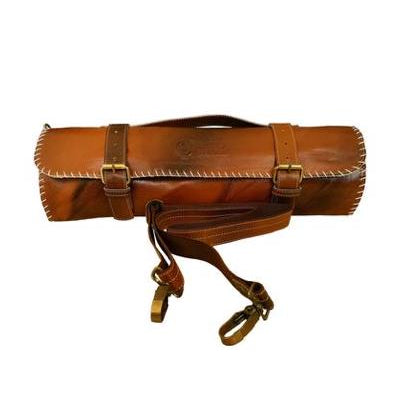
A proper leather knife roll does three things a cheap bag can't: it protects your edges, it survives four years of daily commuting to class, and it doesn't embarrass you when you walk into a professional kitchen for your externship. Look for full-grain leather, individual slots, and a shoulder strap — you'll be carrying this thing constantly.
It also happens to be the gift a lot of culinary students hope someone buys them before day one. (If a parent's reading over your shoulder: hi.)
Don't forget the apron
You'll be in an apron every single class. A durable cross-back apron saves your neck — literally — over long lab sessions, and one with reinforced pockets keeps your thermometer and towels where you can reach them.
Smart packing tips
-
Label everything. In a lab of 20 students, identical kits get mixed up instantly. A custom-embroidered roll or apron solves this and looks sharp.
-
Don't buy the most expensive knives on day one. A solid mid-range chef's knife you maintain well beats a premium blade you're scared to use. Upgrade once you know your preferences.
-
Invest in the carry, not just the cutlery. The roll outlives the knives if you buy it right.
The complete checklist
Knives: chef's, paring, boning, bread, slicer, honing steel.
Tools: peeler, fish spatula, offset spatula, bench scraper, thermometer, tweezers, ring molds, measuring spoons.
Carry: full-grain leather knife roll with individual slots and a shoulder strap.
Wear: cross-back apron with pockets.
Smart move: get the roll and apron customized with your name so nothing walks off.
Pack it right once and you're set for the whole program — and for the kitchen you walk into after it.
Shop knife rolls built for culinary students →
Frequently Asked Questions
What knives do I need for culinary school?
Most programs require a chef's knife, paring knife, boning knife, bread knife, slicer, and a honing steel. Check your specific school's list, but those six are the standard core.
Do I need an expensive knife set for culinary school?
No. A reliable mid-range set you maintain well is better than premium knives you're afraid to use. Spend on a durable knife roll to protect them — that's what lasts.
What's the best way to carry knives to culinary school?
A leather knife roll with individual slots and a shoulder strap. It protects the edges, survives daily commuting, and looks professional during externships.