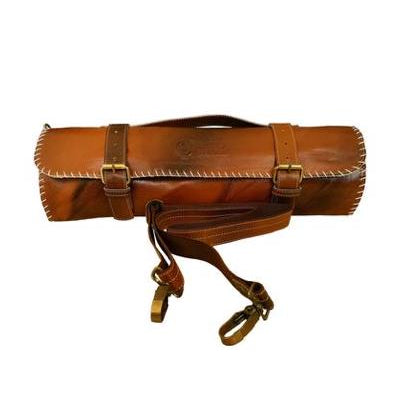
Your knives are the most expensive, most personal tools you own. The bag you carry them in should respect that — and most don't.
After ten years working professional kitchens, I've watched more cheap knife bags fall apart than I can count. Zippers that blow out in a year. Nylon that frays. Foam slots that compress until your knives rattle around loose. So here's the honest guide I wish someone had handed me on day one: how to actually choose a knife roll that lasts.
1. Material decides everything
The single biggest factor in how long your knife roll lasts is what it's made of.
Nylon and polyester are cheap and light, but they're disposable. They abrade, the stitching gives out, and they look beaten within a season of real use.
Waxed canvas is a big step up — durable, water-resistant, and it ages well.
Full-grain leather is the top tier. It's the strongest, most natural cut of the hide, and unlike synthetics it doesn't wear out — it breaks in. A full-grain leather roll picks up character with every shift and can genuinely last decades. It costs more up front and saves money over five years, because you buy it once.
If you're choosing a roll you'll carry for a career, leather is the answer. If it's occasional home use, waxed canvas is a reasonable middle ground.
2. Count the slots — and how they're built
Match the slot count to your kit. Most working chefs land between 6 and 8 knives once you count a chef's knife, paring knife, boning knife, bread knife, slicer, and a couple of specialty blades.
Just as important as the number is the construction. You want individual slots that keep edges fully separated — never a single open pocket where blades knock into each other. Knives that touch chip each other, and they surprise your fingers when you reach in. Our leather knife roll uses eight individually stitched slots for exactly this reason.
3. The strap is not an afterthought
If you commute to your kitchen — and most cooks do — you're carrying this thing through parking lots, on trains, up stairs, at 6am. A roll with no strap means it's awkward in your hands the whole way. Look for a sturdy, comfortable shoulder strap, ideally one that's removable so you can stow it when the roll lives in a locker.
4. How it closes
A knife roll should roll tight and stay shut. Ties and buckles both work; what matters is that nothing shifts in transit and no edge is ever exposed. Test the closure with the roll full, not empty — an empty roll closes easily; a loaded one is the real test.
5. Buy for the long game
Here's the math that changed how I think about gear. A $40 nylon bag you replace every 18 months costs you more over five years than one well-made leather roll you buy once — and the leather one looks better the whole time. Buy-it-for-life gear is almost always cheaper in the end, and it's a lot less annoying.
Quick checklist
- Full-grain leather or waxed canvas — skip thin nylon
- Individual slots sized to your actual kit (usually 6–8)
- A comfortable, ideally removable shoulder strap
- A closure that holds firm when the roll is full
- Construction you'd trust for years, not months
A good knife roll is one of those purchases you only make once if you make it right. Spend a little more, carry it for a decade, and never think about it again.
Shop the handmade leather knife roll →
Frequently Asked Questions
How many knives should a knife roll hold?
Most working chefs carry 6–8 knives. Choose a roll with individual slots that matches your kit, with one spare slot for growth.
Is a leather knife roll worth it over nylon?
For anyone using it regularly, yes. Full-grain leather lasts far longer than nylon and ages better, making it cheaper per year of use despite the higher upfront price.
How do I care for a leather knife roll?
Wipe it dry after wet shifts and condition it with a neutral leather balm every few months. Darkening and small scratches are patina, not damage.